
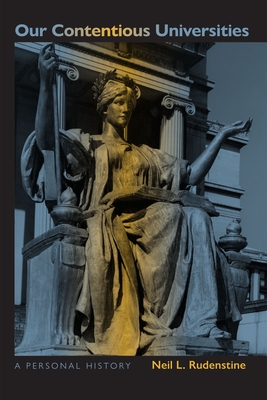
Our Contentious Universities: A Personal History
| AUTHOR | Rudenstine, Neil L. |
| PUBLISHER | American Philosophical Society Press (03/04/2025) |
| PRODUCT TYPE | Hardcover (Hardcover) |
Description
How universities have become increasingly contentious since the Sixties, from the viewpoint of a former Princeton provost and Harvard president
From his days at Princeton University as a member of the faculty, dean, and provost, and his time as a faculty member and president at Harvard University, Neil L. Rudenstine has been uniquely positioned to observe the changes that have occurred in higher education over the past few decades. In this book, he draws on his various roles to present an educator's inside account of the modern university. More than that, Our Contentious Universities is a personal history of how our current campus climate of antagonism evolved, beginning with the late 1960s and up to our contemporary moment. Starting with his perceptions of the anti-Vietnam War events at Columbia, Princeton, and Berkeley, as well as descriptions of what occurred at Harvard, Michigan, and other institutions, Rudenstine identifies a pattern that was characterized by students protesting against institutions because of purported university support for the Vietnam War. Not surprisingly, once the Vietnam War ended, the protests ceased. In contrast, Rudenstine reveals how contemporary campus conflicts essentially differ in nature from the Sixties protests. Since the issues that spark these present protests--such as climate change, conservative judicial opinions, lack of gun control legislation, the Hamas-Israeli war--are clearly not readily soluble problems, there can be no easily defined end to the action. Rudenstine also depicts how universities themselves have changed substantially over the past few decades. The institutions have not only evolved into a collection of decentralized quasi-autonomous departments in competition with other centers and initiatives for resources but also nurtured a highly diverse population of faculty and students with a variety of backgrounds and perspectives already at odds before they even encounter each other on campus. Combining an analysis of how universities transformed with an examination of how protests changed, the book argues that, opposed to the external causes of student protest in the Sixties, it is actually the internal sources of division and conflict that now characterize our universities that are at the root of their contentious campus environments.
Show More
Product Format
Product Details
ISBN-13:
9781606180075
ISBN-10:
160618007X
Binding:
Hardback or Cased Book (Sewn)
Content Language:
English
More Product Details
Page Count:
312
Carton Quantity:
24
Product Dimensions:
6.00 x 1.20 x 9.10 inches
Weight:
1.25 pound(s)
Feature Codes:
Bibliography,
Index,
Price on Product
Country of Origin:
US
Subject Information
BISAC Categories
Education | Administration - Higher
Education | United States - 20th Century
Education | United States - 21st Century
Dewey Decimal:
378.198
Library of Congress Control Number:
2024017665
Descriptions, Reviews, Etc.
publisher marketing
How universities have become increasingly contentious since the Sixties, from the viewpoint of a former Princeton provost and Harvard president
From his days at Princeton University as a member of the faculty, dean, and provost, and his time as a faculty member and president at Harvard University, Neil L. Rudenstine has been uniquely positioned to observe the changes that have occurred in higher education over the past few decades. In this book, he draws on his various roles to present an educator's inside account of the modern university. More than that, Our Contentious Universities is a personal history of how our current campus climate of antagonism evolved, beginning with the late 1960s and up to our contemporary moment. Starting with his perceptions of the anti-Vietnam War events at Columbia, Princeton, and Berkeley, as well as descriptions of what occurred at Harvard, Michigan, and other institutions, Rudenstine identifies a pattern that was characterized by students protesting against institutions because of purported university support for the Vietnam War. Not surprisingly, once the Vietnam War ended, the protests ceased. In contrast, Rudenstine reveals how contemporary campus conflicts essentially differ in nature from the Sixties protests. Since the issues that spark these present protests--such as climate change, conservative judicial opinions, lack of gun control legislation, the Hamas-Israeli war--are clearly not readily soluble problems, there can be no easily defined end to the action. Rudenstine also depicts how universities themselves have changed substantially over the past few decades. The institutions have not only evolved into a collection of decentralized quasi-autonomous departments in competition with other centers and initiatives for resources but also nurtured a highly diverse population of faculty and students with a variety of backgrounds and perspectives already at odds before they even encounter each other on campus. Combining an analysis of how universities transformed with an examination of how protests changed, the book argues that, opposed to the external causes of student protest in the Sixties, it is actually the internal sources of division and conflict that now characterize our universities that are at the root of their contentious campus environments.
Show More
List Price $34.95
Your Price
$34.60